
Walmart shelf-ready packaging (SRP/PDQ) requirements, explained
Walmart wants secondary packaging that moves from the truck to the shelf in one motion — stocks fast, shops clean, and disposes without a fuss. Here are the general engineering rules behind shelf-ready packaging, framed honestly, because the binding specs live in Walmart's supplier portal, not in a blog.
THE SHORT ANSWER
Walmart shelf-ready packaging (SRP) — often called a PDQ, for "pretty darn quick" display — is secondary packaging engineered to go straight to the shelf: a printed corrugated tray or display that ships the product, opens without tools, sits on the shelf, sells the product, and disposes cleanly. The design goal is faster restocking and better on-shelf availability across a lot of stores. The engineering goal is a pack that survives distribution and still looks retail-clean when it lands.
- SRP = shelf-ready packaging; PDQ = a "pretty darn quick" display unit — same idea, different formats
- A good design nails the "five easys": easy to identify, open, shelve, shop, and dispose
- The tray has to survive shipping and look clean on the shelf — a real board-strength balancing act
- The exact perforation, print, dimension, case-pack, and label specs are Walmart's to publish — pull the current version from the supplier portal
- Walmart Marketplace and WFS are a different requirement set from in-store retail SRP
Requirements/timelines change. This page was last verified against Walmart's supplier portal (Retail Link) on 18 July 2026. Always confirm the current version with Walmart's supplier portal before you rely on it — the binding perforation, print, dimension, case-pack, and labeling specs live there, not in a blog. This is general guidance, not legal or compliance advice.
What shelf-ready packaging is, and why Walmart wants it
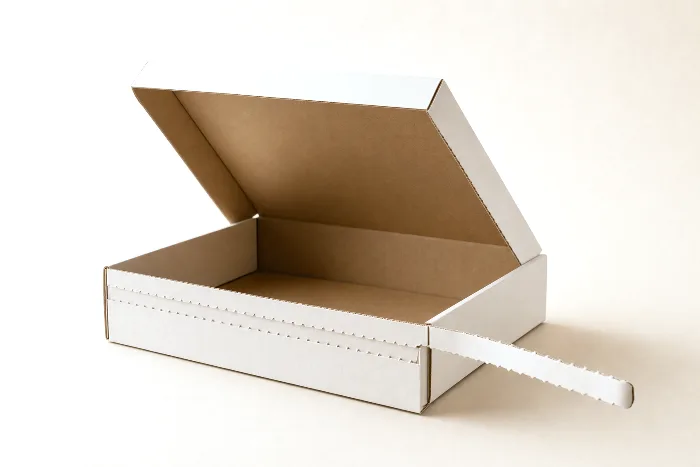
Shelf-ready packaging (SRP) — also called retail-ready packaging (RRP), or in display form a PDQ — is the secondary packaging that carries multiples of a product and is designed to go onto the sales floor as a unit, without an associate unpacking each item. Instead of opening a plain shipping case, pulling out units, and hand-facing them, a stocker cuts one perforation, lifts off a lid, and slides the whole tray onto the shelf. The product is already faced and priced-to-shop.
Walmart cares about this for one blunt reason: it operates at enormous scale, and every second of shelving labor multiplied across a huge store fleet is real money and real on-shelf availability. A pack that a store team can open and place in one motion restocks faster, empties into the aisle more predictably, and reduces the odds of a gap where a product should be. That is why so many categories move toward tray and display formats — the format is a labor and availability decision as much as a marketing one. This article is part of our guide to packaging by sales channel, and it pairs closely with the broader retail-ready packaging requirements that apply across grocery and mass retail.
The "five easys" every retail-ready pack has to hit
The retail industry commonly describes good shelf-ready packaging with a "five easys" framework. It is a useful design checklist no matter which retailer you are selling into, because it captures what a store team and a shopper actually need from the pack.
| Easy | What it means | What the pack must do |
|---|---|---|
| Easy to identify | A stocker can tell what's inside at a glance | Clear product name, variant, and code printed on the case and the tray faces |
| Easy to open | Opens cleanly without a knife slip or torn units | A designed tear/perforation path that separates the display from the lid in one pull |
| Easy to shelve | Fits the shelf and slides in as a block | Tray footprint sized to the planogram; stable enough to lift full |
| Easy to shop | The shopper sees and reaches the product | Front and units visible and accessible once the tray is on the shelf |
| Easy to dispose | The empty collapses flat for recycling | A structure that folds down cleanly and separates from any non-recyclable parts |
If a design fails any one of these, it usually shows up as friction in the aisle: a knife slice through the top units, a tray that sags when lifted, a display that hides the product it is supposed to sell, or a mess of board the store has to break down by hand. Nail all five and the pack does its job invisibly.
The engineering rules behind a shelf-ready tray
Under the graphics, a shelf-ready tray is a structural-engineering problem with a built-in tension: the same box has to survive shipping and look clean once the top comes off. Those two jobs pull in opposite directions, and resolving them is most of the craft.
- A designed open — perforation and tear. The pack needs a controlled way to separate the display portion from the shipping portion. That is a zip/perforation or a nick-and-tear line placed so the tear releases the lid without exposing the product to a blade and without shredding the tray wall. The exact perforation geometry a given program wants is a spec you verify, not a number you guess.
- Board strength that does two jobs. The tray has to carry a stack in transit and hold its shape on the shelf after part of the structure is torn away. That is fundamentally a corrugated box strength question — the flute, the board grade, and the removed material all change how much compression the remaining tray can take. Removing a lid or cutting a front window lowers the tray's residual strength, so the design has to leave enough structure behind to keep a full facing standing.
- Tray geometry. The workhorse format is the die-cut corrugated tray — see the corrugated tray style for the base structure. Its walls, corner posts, and any tear-away front are tuned to the product's height and weight and to the shelf it has to sit on. Taller or heavier product means more residual wall; a light product can carry a lower tray with a bigger shopping window.
- Print and finish. The tray's exposed faces are now brand real estate, which raises the usual print questions — registration, coverage over kraft or coated liner, a scannable barcode. How much print a program expects, and where, is a retailer spec, not a universal rule.
The honest summary: there is no single "Walmart tray strength" to copy. There is a set of trade-offs — open cleanly, ship intact, stand full, shop well — that you engineer for your product, then validate against the current program spec.
Case pack, pallet alignment, and GS1 case labeling
A shelf-ready tray does not live in isolation — it is a case pack that has to palletize efficiently and scan correctly through the supply chain. Three things travel together here.
- Case pack count. How many selling units go in a tray drives everything downstream: the tray size, how trays stack, and how the pallet builds. Retailers frequently have expectations about case-pack counts for a category, and those are program-specific — confirm the count your buyer expects before you tool a tray around the wrong number.
- Pallet alignment. Trays should tile into a clean, stable pallet with a sensible Ti-Hi (units per layer × layers) so the load cubes out without overhang or wasted space. A tray sized so a whole number of them fills a pallet layer ships better and damages less — run the layout in the pallet calculator and check how many boxes fit per pallet before you lock dimensions. Overhang and column mis-stacking are two of the most common causes of crushed shelf-ready trays in transit.
- GS1 case labeling. The shipping case or tray carries a case-level barcode — commonly a GTIN-14 in an ITF-14 symbol — and pallets carry an SSCC license-plate label, both governed by GS1 US standards. The type of code and where it goes follow well-established GS1 conventions; the exact placement, size, and which symbologies a program mandates are things you confirm in the retailer's current labeling guidance rather than assume.
Get the case pack, the pallet math, and the labels aligned early. They are cheap to change on paper and expensive to change after tooling. If your product also has to serve other buyers, the channel packaging requirements matrix lays the differences side by side.
Where the binding Walmart specs actually live
Here is the part a lot of "Walmart SRP requirements" articles get wrong: they publish a specific perforation depth, a specific tray dimension, a specific print rule, or a specific case-pack count as if it were a fixed law. It is not. Those specifics are set by Walmart, they vary by category and by program, and they change over time. Building tooling off a number you read on a blog — including this one — is how suppliers end up with a rejected pack and a chargeback.
The authoritative source is Walmart's supplier portal, historically known as Retail Link, along with the supplier and packaging guidance published there for your specific program. That is where the binding perforation, printing, dimension, case-pack, and labeling requirements live, and it is where they are kept current. Treat this article as a way to understand what kinds of requirements exist and why — then pull the exact, current values for your program from the portal before you commit to a die.
A practical way to work: use the general principles here to design a candidate tray and pallet, then confirm and reconcile against the current binding specs in the supplier portal before tooling. If the two ever conflict, the portal wins.
Walmart WFS is a different requirement set
It is easy to conflate "selling on Walmart" into one packaging problem, but there are two very different worlds. In-store retail SRP is about a tray or display on a physical shelf. Walmart Fulfillment Services (WFS) and Walmart Marketplace are ecommerce fulfillment — Walmart stores and ships your individual units to online shoppers, much like third-party fulfillment on other marketplaces.
That flips the packaging priorities. WFS cares about individual-unit prep: a scannable unit barcode, poly-bag and suffocation-warning handling where it applies, protection for a unit shipped alone, and dimensional efficiency for the parcel — not shelf display or tray strength. A product sold both in stores and through WFS typically needs two different packaging approaches: a shelf-ready case for the retail floor and a fulfillment-ready unit for the ecommerce channel. We cover the online side separately in Walmart WFS packaging requirements.
How PackOS helps you get retail-ready
Shelf-ready packaging is where structure, print, and logistics collide — the tray has to fold, hold, ship, and sell at once, and each constraint changes the others. PackOS keeps them in sync: upload artwork or a die file and it reconstructs an editable, parametric dieline, so changing a tray dimension or a case-pack count reflows the panels, the pallet math, and the print area together instead of drifting out of alignment. You can see how the logistics side is modeled on the technology page, size a case with the case size calculator, and pressure-test the load with the pallet calculator. When you are ready to price a real tray, start a Quick Quote — then confirm the binding details against Walmart's supplier portal before you tool.
Frequently asked questions
What is Walmart shelf-ready packaging (SRP)?
Shelf-ready packaging is secondary packaging — usually a printed corrugated tray or display — engineered so a store associate can move product from the truck to the shelf in one motion, without unpacking individual units. Walmart also uses the term PDQ, meaning a "pretty darn quick" display. The goal is faster restocking, better on-shelf availability, and a clean, shoppable presentation.
What is the difference between SRP and PDQ?
They describe the same idea from different angles. SRP, or shelf-ready packaging, is the general term for secondary packaging that goes straight to the shelf. PDQ, or pretty darn quick, usually refers to a ready-made display unit — often a tray or floor unit — that is placed as-is. In practice retailers use both terms, and the required format depends on the product, the category, and the store set.
Does Walmart require shelf-ready packaging for every product?
No. Requirements vary by category, by program, and over time, and not every item is sold from a shelf-ready tray or display. Some categories are shelved from standard cases, while others require a specific display format. The only authoritative answer for your item is the current specification in Walmart's supplier portal for your program.
Where do I find Walmart's exact shelf-ready packaging specs?
In Walmart's supplier portal — Retail Link and the associated supplier and packaging guidance. The binding perforation, printing, dimension, case-pack, and labeling specifications live there and are updated over time, so a blog cannot substitute for them. Confirm the current version for your specific program before you build tooling.
Is Walmart Marketplace or WFS packaging the same as shelf-ready packaging?
No. Walmart Fulfillment Services and Walmart Marketplace are ecommerce fulfillment channels, so their packaging rules focus on individual-unit prep, poly-bagging, and scannable barcodes rather than on shelf display. Shelf-ready packaging is about in-store retail. A product sold through both channels typically needs two different packaging approaches.