
Why does my packaging smell like chemicals — and is it safe?
New packaging can arrive smelling like a paint locker — sharp and solventy, or waxy and plastic. Most of the time it airs out; sometimes it's a signal something went wrong at the press or the laminator. Here's how to tell the difference, fast.
THE SHORT ANSWER
Why does my packaging smell like chemicals — most often it's retained printing or lamination solvent, off-gassing from fresh polyethylene, or ink and board odor. A mild smell that airs out over hours to a few days is usually normal off-gassing. A strong, persistent solvent smell that transfers to the product is treated as a quality reject, not a nuisance. The three usual sources:
- Retained solvent — from solvent-based inks, coatings, or lamination adhesives; sharp and solventy
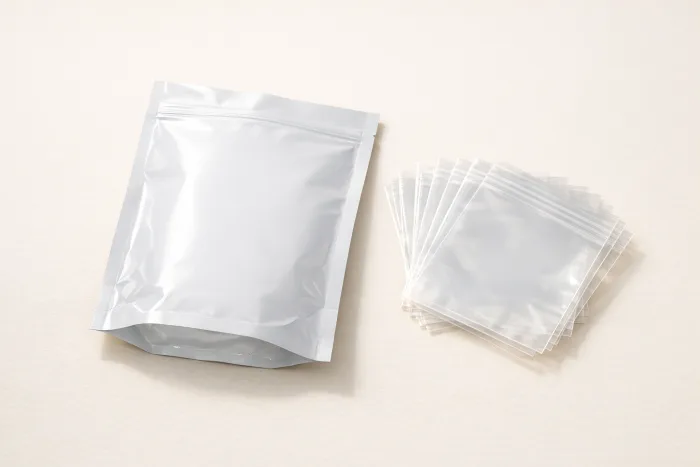
- Fresh polyethylene off-gassing — new LDPE/HDPE film and poly bags; waxy or plastic, fades with air
- Ink and board odor — printed corrugated and paperboard; inky or musty
- The safety line — if you can taste or smell it on the product, stop and treat it as a reject
In a hurry? Describe the odor to the free packaging symptom checker and it walks you from the smell to the likely cause and the next step. Try the packaging symptom checker →
What you're actually smelling
A "chemical" smell is your nose picking up volatile organic compounds — small molecules light enough to evaporate off a material's surface and reach you. In packaging they come from a short list of places: the solvents that carry inks, coatings, and adhesives; the additives and residues in freshly extruded plastic film; and the paper, board, and printing on a corrugated box. The question that matters is not whether your packaging gives off an odor — almost all packaging does, faintly, when new — but whether it's the normal, fading kind or the kind that signals a process problem and can taint what you put inside.
Terminology helps, because a "chemical smell" covers three genuinely different situations, each with a different fix.
Why does my packaging smell like chemicals: the three common sources
When people ask us why does my packaging smell like chemicals, the answer is almost always one of three sources. You tell them apart by the character of the smell and by what kind of packaging you're holding.
1. Retained solvent from printing or lamination
This is the classic sharp, solventy, marker-or-nail-polish smell, and it's the one to take most seriously. Solvent-based inks and the adhesives used to laminate flexible films are carried in solvents such as ethyl acetate or isopropyl alcohol. During drying and curing those solvents are meant to flash off almost completely. When a job runs too fast, dries too cool, or is cased before it has fully cured, a little solvent stays trapped between the layers — "retained solvent" — and out-gasses slowly for days or weeks, sometimes migrating into the product. This residual-solvent odor is most common on solvent-based gravure and some flexo work, and on laminated flexible structures, so a lingering flexible packaging odor after airing is the classic tell. The same under-cure that traps solvent can also cause delamination, so the two often travel together.
2. Off-gassing from fresh polyethylene
Brand-new polyethylene — LDPE and HDPE poly bags, liners, and film — has a mild waxy, plastic smell of its own. It comes from the resin and from the slip and anti-block additives that keep the film from sticking to itself, plus trace processing residues. This is the "new poly bags smell" people notice when they open a fresh case of mailers or liners. It is usually cosmetic, fades with a day or two of airing, and should never be sharp — if it is, suspect ink or solvent, not the resin.
3. Ink and board odor on printed boxes
Corrugated and folding cartons have their own signature: an inky, papery, sometimes musty smell. Freshly printed boxes smell like ink because the coatings and inks are still curing; recycled fiber adds a mustier note; and damp or hot storage amplifies both. When customers tell us their printed boxes smell like ink, it's usually this — a surface odor that dissipates as the board breathes, not something trapped in a laminate.
Use this to triage what you're smelling:
| Likely cause | What it smells like | Why it happens | Usually normal or a reject? |
|---|---|---|---|
| Retained print / lamination solvent | Sharp, solventy, marker- or nail-polish-like | Solvent-based ink or adhesive under-cured, or cased too soon | Reject if strong or persistent, or if it transfers to product |
| Fresh polyethylene off-gassing | Mild waxy or plastic | Resin plus slip/anti-block additives in new film | Normal — airs out; reject only if it transfers |
| Ink and board odor | Inky, papery, sometimes musty | Curing inks and coatings; recycled fiber; damp or hot storage | Usually normal — dissipates as the board breathes |
| Musty / mildew | Damp, earthy, moldy | Moisture in storage or transit, not a converting defect | Reject the affected units; fix the storage |
Normal off-gassing, or a real reject?
Here is the honest dividing line a good converter uses. The smell is normal off-gassing when it is mild, it clearly fades as the packaging airs out, and — most important — it does not transfer to the product. It's a reject when it is strong and persistent after airing, or when you can taste or smell it on whatever you put inside. Odor or taste transfer to a food, supplement, beverage, or cosmetic is a quality defect: the FDA's food-contact framework treats packaging that imparts odor or taste to a food as a problem with the food itself. Verify the specifics for your product with the FDA and a qualified food-safety professional, and see our overview of food packaging regulations for the wider picture.
A few quick tests to place your situation:
- The jar test. Seal a sample of the packaging with a little of your product (or a neutral, unsalted cracker) in a clean glass jar overnight at room temperature, then open and smell and taste. Transfer means reject.
- The airing test. Open a few units in a ventilated space for a day or two. Normal off-gassing drops noticeably; retained solvent barely moves.
- The character test. Waxy/plastic and inky/papery are usually benign; sharp and solventy after airing is the red flag. Unsure which you've got? The symptom checker maps these cues to a likely cause.
How to get the smell out (and keep it out)
If the odor is the benign, airing-out kind — or you're waiting on your converter — work down this list. Steps 1–4 address a mild odor on your side; steps 5–6 prevent it on the next run.
- Air it out before filling. Break down the cases and let the packaging breathe in a clean, dry, ventilated area for a day or more. Most fresh-film and fresh-ink odor drops sharply.
- Separate packaging from strong-smelling stock. Corrugated readily picks up odors from its neighbors — solvents, cleaning chemicals, produce. Store it away from anything aromatic.
- Control temperature and humidity. Heat accelerates off-gassing and damp invites musty odor; a cool, dry warehouse is the cheapest odor control there is.
- Re-run the transfer test after airing. Don't fill until a fresh jar test comes back clean. If it still transfers, it's a reject — take it to your converter.
- Spec low-odor systems up front. For food and scent-sensitive products, ask your converter for water-based or UV/EB-cured inks and low-odor or solventless lamination adhesives, and specify a full cure and dwell before shipping.
- Build cure and dwell into the schedule. Retained solvent is usually a "cased too soon" problem. Giving laminated film adequate cure time before it's slit, wound, and packed is the single biggest lever — say so in your spec and on the PO.
Is it your fault or your supplier's?
When a buyer asks us why does my packaging smell like chemicals and who's responsible, the answer usually splits along a clean line. It's the supplier's when the material arrives already smelling strongly of solvent, when the odor transfers to product straight out of the case, or when it's tied to under-cured lamination or ink — those are process controls the converter owns. It's on your side when packaging that arrived fine picked up odor in your warehouse: stored beside solvents or cleaning supplies, filled while still tightly cased and un-aired, or held somewhere hot and damp. Fresh-film and fresh-ink off-gassing that simply needed airing is nobody's defect — a day of ventilation fixes it. Being honest about which bucket you're in gets the problem solved faster.
When to escalate — and when to reject the lot
Escalate to your converter when the smell is strong or solventy after airing, when it transfers to product in a jar test, when it appears alongside delamination or weak seals, or when a lot smells different from previous shipments. Ask them to check cure and dwell times, the ink and adhesive system, and residual-solvent results. Hold the suspect lot, keep a retained sample, and note lot numbers and dates before anything is filled. This diagnostic belongs to a family of packaging problems — our packaging problems diagnostic library covers the neighboring ones. When in doubt, don't fill: an odor complaint costs far more than a held pallet.
How PackOS heads off odor complaints at spec time
Most odor problems are decided long before the smell reaches your nose — in the ink system, the adhesive, and the cure schedule chosen at spec time. PackOS captures those choices as structured spec data, so the ink, coating, lamination, and substrate for a food or scent-sensitive job are recorded and carried into the quote and production route, not left to chance on the floor. You can see how the quality and preflight layer works on the technology page, or put a real job in front of it with a Quick Quote and specify the low-odor system you need.
Frequently asked questions
Why does my packaging smell like chemicals?
Most often the smell is retained solvent from solvent-based printing inks or lamination adhesives, off-gassing from fresh polyethylene film, or plain ink and board odor from a printed corrugated box. Solvent retention smells sharp and solventy; fresh polyethylene smells waxy or plastic; board and ink smell inky or musty. A mild odor that airs out over hours to a few days is usually normal off-gassing, while a strong, persistent solvent smell that transfers to the product is treated as a quality reject.
Is a chemical smell in packaging dangerous?
A faint plastic or waxy odor from new film that fades with airing is generally not a safety problem. The concern is a strong solvent smell that transfers taste or odor to a food, supplement, or cosmetic product inside, which is treated as a defect rather than a nuisance. If odor transfers to the product, treat it as a quality and food-safety reject and consult your converter and a qualified food-safety professional. This article is general guidance, not a safety determination.
How long does the chemical smell in new packaging take to go away?
It varies by material, ink and adhesive system, and how the packaging was stored and shipped. Mild off-gassing from fresh polyethylene or water-based print usually dissipates over hours to a few days of airing in a ventilated space. A solvent smell that is still strong after the packaging has aired out points to retained solvent or an under-cured lamination, which will not simply air away and should go back to the converter.
Why do my new poly bags smell like plastic or chemicals?
Fresh polyethylene poly bags carry a mild waxy or plastic odor from the resin and from slip and anti-block additives. That smell normally fades with airing and is usually cosmetic. A sharper solvent smell on a printed poly bag more likely comes from the ink or from residual processing solvent. Air the bags out before filling, and if the smell is strong or transfers to the contents, ask your supplier about the resin, additives, and ink system.
Can I still use packaging that smells like chemicals?
If the odor is mild, airs out, and does not transfer to the product, the packaging is usually usable, so air it out before filling. If the smell is strong, persistent, or you can taste or smell it on the product, do not use the lot for a consumable or scent-sensitive product. Document it, keep a retained sample, and raise it with your converter as a quality issue before you fill and ship.