
Rotogravure printing explained, for packaging
If you have ever opened a snack bag, a coffee pouch, or a case of shrink-wrapped multipacks, there is a good chance the graphics came off an engraved cylinder. Rotogravure is the quiet workhorse behind high-volume flexible packaging — here is how it works, where it wins, and when it is the right call.
THE SHORT ANSWER
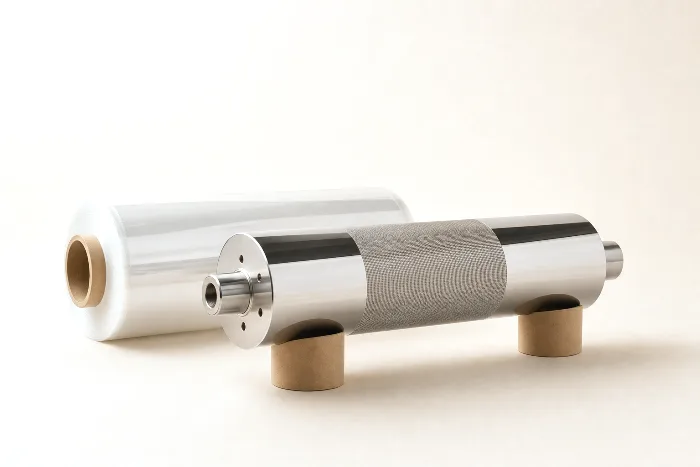
Rotogravure — usually shortened to gravure — prints by transferring ink out of countless tiny cells engraved into a solid metal cylinder, directly onto the substrate. Because the image is cut into the cylinder itself, gravure reproduces the same rich solids and fine detail impression after impression, which makes it the standard for very long, high-volume flexible-packaging runs. The catch is the cylinder: engraving one per color is a real investment, so gravure earns its keep at high volume, not on short jobs.
- Engraved cylinder — the image lives as recessed cells in a metal cylinder, one cylinder per color
- Exceptional consistency — the same solids and detail across extremely long runs
- High-volume economics — heavy cylinder tooling pays off over millions of impressions, not on short or frequently changing work
- Built for flexible film — snack bags, pouches, wraps, and other packaging printed in high, stable volume
What rotogravure printing is
Rotogravure is an intaglio process, which is a fancy way of saying the image sits below the surface of the printing cylinder rather than raised above it. Ink is held in millions of microscopic recesses — the cells — that are engraved into a polished metal cylinder. As the cylinder turns, it picks up ink, a blade wipes the smooth surface clean, and the ink left sitting in the cells transfers onto the material passing over it. The "roto" simply refers to the fact that everything happens on a rotating cylinder, on a continuous web of material, at speed.
That puts gravure in a different family from the other two big packaging methods. Flexography is a relief process — the image is raised on a flexible plate, like a rubber stamp. Offset lithography is planographic — the image and non-image areas sit on the same plane and are separated chemically. Gravure is the recessed one, and that single structural difference is the source of both its greatest strength (consistency) and its biggest cost (the cylinders).
How gravure works: cells, cylinder, and the doctor blade
A gravure press has one printing station per color, and each station works the same way. Walk it through once and the whole method clicks:
- Engrave the cylinder. A machined steel base is plated with copper, and the image is cut into that copper as a grid of cells — historically with a diamond stylus, now often with a laser. Cells that are deeper or wider hold more ink and print darker; shallow, small cells print lighter. That variation in cell volume is how gravure renders tone.
- Chrome-plate for durability. The engraved copper is usually plated with a thin, hard chrome layer so it survives a very long run without wearing the fine cells away.
- Ink the cylinder. The lower part of the cylinder runs through a bath of low-viscosity, fast-drying ink, flooding every cell.
- Wipe with the doctor blade. A thin steel blade — the doctor blade — scrapes the polished surface clean, leaving ink only down inside the cells. This is the moment that makes gravure so repeatable: the surface is metal, and metal does not change shape.
- Transfer to the web. An impression roller presses the substrate against the cylinder so the ink lifts out of the cells and onto the material. The web then passes through a dryer before the next color.
Repeat that station for each color, register the stations to one another, and you have a full-color print. Because tone comes from cell depth rather than from a pattern of dots that grows and shrinks, gravure holds smooth gradients and dense solids extremely well — the same qualities good color management is designed to protect from press to press.
Where gravure wins
Gravure is not the flashiest method, but on the jobs it is built for it is very hard to beat. Its strengths cluster around length and richness:
- Consistency over enormous runs. The image is engraved into hardened metal, so the last impression in a run measured in the millions looks like the first. For a brand printing the same design for months, that stability is the whole point.
- Speed. Gravure runs a continuous web at high line speeds, so once it is set up it turns huge volumes in a hurry.
- Rich, dense solids and fine detail. Deep cells lay down heavy, even ink films, which is why gravure is prized for saturated colors, metallics, and near-photographic imagery.
- Broad substrate range. It prints films, paper, and foil, which is why it dominates flexible packaging and also prints high-circulation magazines and catalogs (publication gravure).
- Predictable color match. Because the carrier does not deform, a well-built gravure job holds color targets tightly — a natural fit for tightly specified brand colors, whether those run as process or as a spot color.
The trade-offs: why cylinders raise the run threshold
Every strength of gravure traces back to the engraved cylinder, and so does every drawback. The cylinder is a machined, plated, precisely engraved piece of metal — one for every color — and that up-front tooling is heavier than a flexo plate and far heavier than a plateless digital run. We keep cost talk qualitative here on purpose, because real numbers move with cylinder count, size, engraving type, and supplier — but the direction is clear: gravure carries the highest set-up cost of the mainstream methods, and it pays that back only across a lot of impressions.
The practical consequences follow from there:
- A high run threshold. Because you amortize the cylinders across the run, the per-unit cost only becomes attractive at high volume. Below that threshold, another method almost always wins.
- Expensive changes. Tweaking artwork usually means re-engraving a cylinder. Frequent design changes, promotions, or many SKU versions fight against gravure's economics.
- Longer lead time to first print. Making cylinders takes time, so gravure adds to the front of the schedule compared with a plate or a digital file.
- Set-up and make-ready. Registering multiple stations and dialing in ink and blade takes material and time before you are running saleable product.
- Solvent handling. Many gravure inks are solvent-based and fast-drying, which brings ventilation and recovery considerations that a converter manages but that belong in the conversation.
None of these are flaws, exactly — they are the price of the consistency. They just mean gravure is a high-volume tool, and using it on a short or fast-changing job is like chartering a freight train to move a single pallet.
Gravure vs flexo for flexible packaging
For flexible packaging — pouches, bags, wraps, and lidding — the real decision is usually gravure versus flexography, because both print films on a web and both can produce excellent results. The honest answer is that they overlap in the middle and the tie-breaker is almost always run length and how often the art changes.
| Factor | Rotogravure | Flexography |
|---|---|---|
| Image carrier | Cells engraved into a solid metal cylinder | Raised areas on a flexible photopolymer or rubber plate |
| Tooling cost & lead time | Higher — a machined, plated, engraved cylinder per color | Lower — a plate per color, faster to make and revise |
| Consistency over a long run | Exceptional — the image is cut into hardened metal | Very good, with attention to plate wear and ink control |
| Best run length | Very long, high, stable volume | Short through long; strongest across the mid-range |
| Fine detail & rich solids | Excellent, near-photographic | Very good and improving; historically a step behind on the finest work |
| Design changes / versioning | Costly — re-engraving a cylinder | Easier — remake a plate |
| Common home | High-volume flexible film and some paper | Labels and most flexible packaging |
A simple rule of thumb: if you are printing one stable design in very high, sustained volume and you care about flawless solids, gravure is often the lower cost-per-unit and the more consistent result. If your volume is moderate, or the art changes, or you run many versions, flexo's cheaper and faster tooling usually wins — and for the shortest runs or heavy versioning, digital may beat both. It is the same job, judged by a different yardstick.
How to choose — and how PackOS fits in
Notice what is not in that decision: any claim that gravure is simply "the best." A printing method is not good or bad in the abstract — it is a fit for a format, a substrate, a run length, a version count, and a set of color needs. That is exactly why PackOS stays deliberately method-agnostic. We do not sell you a single press, so we have no reason to talk you into one. Our job is to make sure your artwork is manufacturable on whatever method the work actually calls for, and to help you see the trade-off clearly. This piece is part of our guide to packaging printing methods, which walks the full set side by side.
If you want to pressure-test the choice for a specific project, the Print Method Selector lets you put in your format, run size, and version count and see which methods realistically fit — gravure included — before you commit to tooling. And once the method is settled, the file still has to be right: correct color space, proper separations, and a clean cut path. How PackOS helps is on the production side — it reads your artwork, checks it against the print-quality requirements of the route you are taking, and rebuilds a manufacturable spec, so the same file that images beautifully on an engraved cylinder would also pass preflight on a flexo or digital line. Method-agnostic in, print-ready out.
Not sure which press your product belongs on? Start with a real file and let the platform show you the fit with a Quick Quote.
Frequently asked questions
What is rotogravure printing?
Rotogravure, or gravure, is a printing method that transfers ink from tiny cells engraved into a metal cylinder onto the substrate. Each color has its own engraved cylinder. Because the image is cut into the cylinder itself, gravure holds the same result across extremely long runs, which is why it dominates high-volume flexible packaging.
What is the difference between gravure and flexo?
Gravure prints from ink-filled cells engraved into a solid metal cylinder, while flexography prints from a raised rubber or photopolymer plate. Gravure gives more consistent solids and detail over very long runs but has higher cylinder tooling cost and lead time. Flexo has cheaper, faster tooling and suits shorter and mid-length runs, so the two overlap in the middle and the run length usually decides.
When does rotogravure make sense?
Gravure makes sense when the run is very long and stable — the same design printed in high volume over a long period — and when consistent solids, fine detail, or rich color matter. The engraved cylinders are an investment, so they pay off across many impressions rather than on short or frequently changing jobs.
Why is gravure tooling so expensive?
Each color needs its own cylinder, and each cylinder is a machined metal base that is plated and then engraved cell by cell, often with a diamond stylus or laser. That precision is what delivers gravure's consistency, but it makes the up-front tooling far heavier than a flexo plate or a plateless digital run, which is why gravure is reserved for high volumes.
Can gravure print on paper and cartons, or only film?
Gravure can print on film, paper, and foil, and publication gravure prints magazines and catalogs. In packaging it is used most for flexible films and some paper, while folding cartons are more often offset and shorter runs are more often flexo or digital. The substrate matters less than the run length and consistency needs.